CISPR 25 Conducted Emissions Countermeasures for Automotive 48 V Power Supply Systems
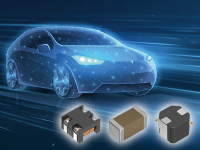
In this solution guide, based on CISPR25, the EMC standard for automotive equipment, we present verification results of the impact on conducted emissions generated by buck converters when the input voltage increases from 12V to 48V, as well as examples of noise countermeasures using filter components under 48V input conditions. If you are facing challenges with EMC countermeasures for 48V power supply systems, we encourage you to read this guide.
 Contact Us
Background and Challenges of Automotive 48 V Power Supply Systems
With the advancement of Advanced Driver Assistance Systems (ADAS) and Autonomous Driving (AD), the electric power demand within vehicles is increasing significantly. In order to increase the supplied power with the conventional 12V power system, it is necessary to increase the current. However, increasing the current leads to issues such as greater power loss and increased vehicle weight due to heavier wire harnesses.
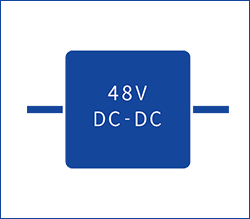
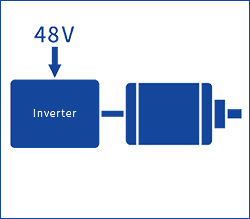
Against this backdrop, the introduction of the "48V power supply system" as a replacement for the conventional 12V power supply system is progressing. 48V power supply systems can reduce the current required to supply the same amount of power to one-fourth by increasing the voltage to four times that of the conventional 12V power supply system. As a result, significant benefits can be obtained, such as reduced power loss and extended driving range through thinner and lighter wire harnesses. On the other hand, the increase in system voltage from 12V to 48V leads to a rise in voltage fluctuations (dV/dt) in switching power supplies, which in turn raises the noise level generated. Therefore, the importance of EMC countermeasures is expected to become a more critical aspect. Additionally, components used on the 48V line require higher rated voltages than before, making it important to select compatible components.
For more information on EMC measures and component solutions for in-vehicle 48V power systems, please also refer to the following article:
Noise Countermeasures and Component Solutions for Automotive 48V Power Supply Systems | Solution Guides | Tech Library | TDK Product Center
Comparison of Conducted Emissions from Buck Converters with 12 V and 48 V Inputs
To confirm the impact of increased system voltage on noise, we conducted a comparative evaluation of noise using buck converters compatible with 12V and 48V inputs.
The evaluation was performed based on the CISPR25 standard, using two methods for conducted emissions: the voltage method and the current probe method.
EUT (Equipment Under Test)
Synchronous rectification buck converter (with spread spectrum function)
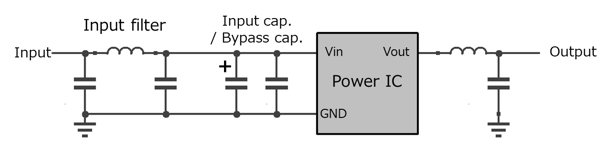
| Configuration | |
| Input Filter | MLCC 4.7μF + L15μH + MLCC 4.7μF×2 |
| Input Cap. | Electrolytic Capacitors 33μF |
| Bypass Cap. | MLCC 4.7μF×2 + 0.1μF×2 |
Test Method
- Standard: CISPR25
- Limit value: Class 5
- Measurement item: Conducted emission
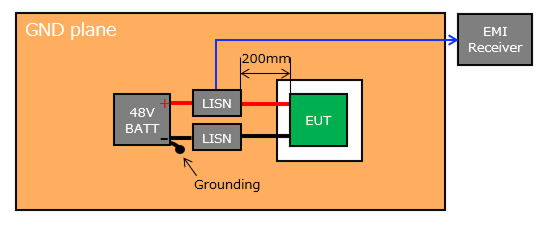
- Voltage method: 150kHz-108MHz
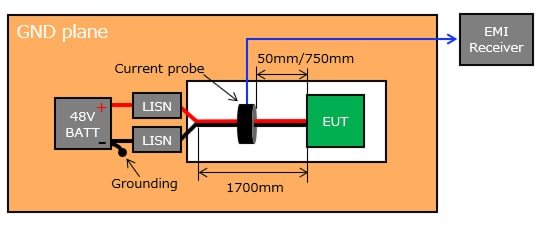
- Current probe method: 150kHz-245MHz
- Conducted emission (voltage method)
- Conducted emission (current probe method)
Operating Conditions
| Condition | Input | Output | Switching Frequency |
|---|---|---|---|
| Condition ① 12V Input | 12V | 5V / 4A(20W) | 400kHz |
| Condition ② 48V Input | 48V | 12V / 1.67A(20W) | 400kHz |
Test Results
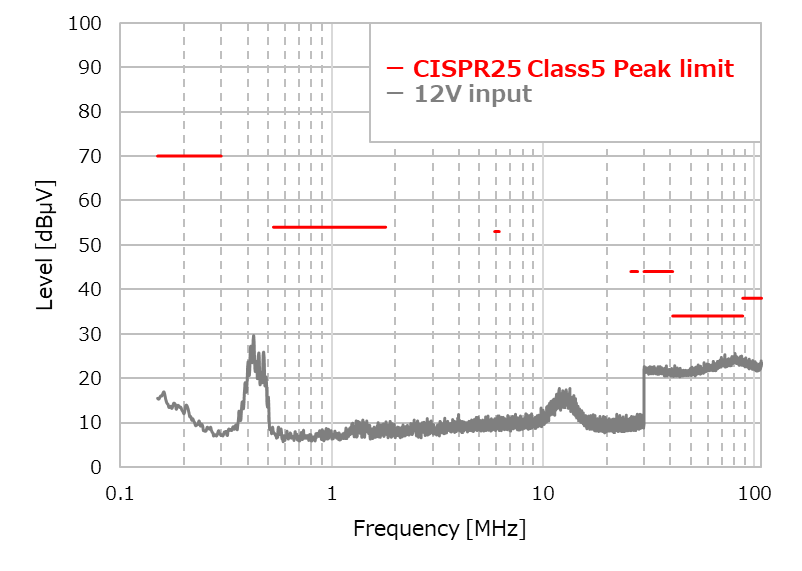
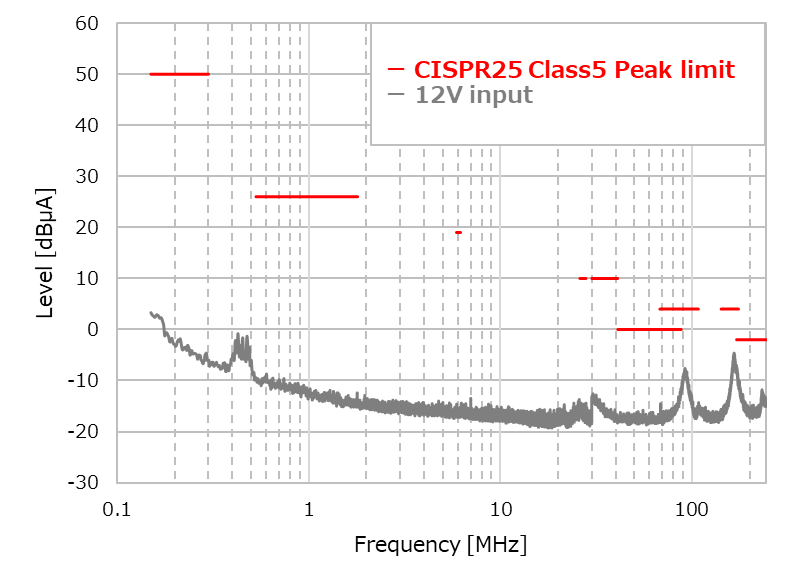
■Condition ① 12V Input
- Conducted emission (voltage method)
- Conducted emission (current probe method)
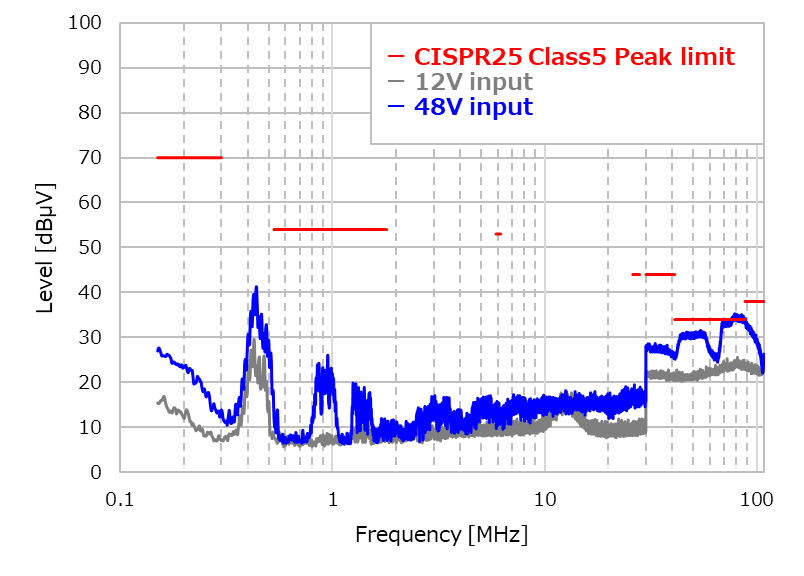
■Condition ② 48V Input
- Conducted emission (voltage method)
- Conducted emission (current probe method)
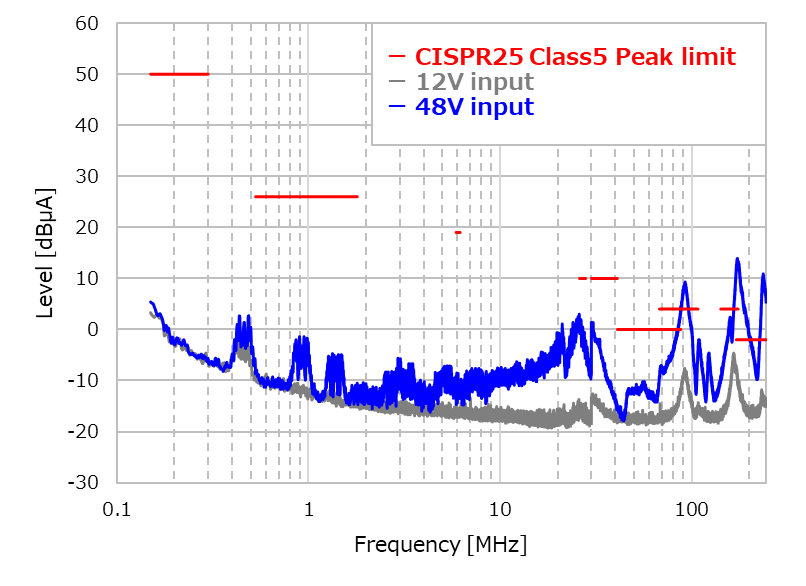
The comparison confirmed that the noise level increased when the input voltage was raised from the conventional 12V to 48V, both in the voltage method and the current probe method for conducted emissions. This is considered to be partly due to the increase in the rate of voltage change (dV/dt) during switching as the input voltage rises. Thus, 48V power supply systems may experience higher noise levels than conventional 12V power supply systems. Therefore, from the perspectives of preventing equipment malfunctions and maintaining reliability, EMC countermeasures are more important than ever.
CISPR 25 Conducted Emissions Countermeasures for Automotive 48 V Power Systems
In 48V power supply systems, there are concerns about increased noise levels compared to conventional 12V power supply systems. Therefore, we examined countermeasures using filter components for CISPR25 conducted emissions of step-down converters with 48V input. The input filter configuration was compared and evaluated using the following three patterns:
- No filter
- π-type filter
- π-type filter + common mode filter for power supply
EUT (Equipment Under Test)
Synchronous rectification step-down converter (with spectrum spreading function)
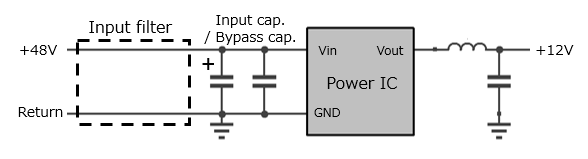
| Configuration | |
|---|---|
| Input Cap. | Electrolytic Capacitors 33μF |
| Bypass Cap. | MLCC 4.7μF×2 + 0.1μF×2 |
Test Method
- Standard: CISPR25
- Limit value: Class 5
- Measurement items: Conducted emission - voltage method 150kHz–108MHz / current probe method 150kHz–245MHz
Operating Conditions
- Input: 48V
- Output: 12V / 5A (60W)
- Switching frequency: 400kHz
Input Filter Configuration
■No filter
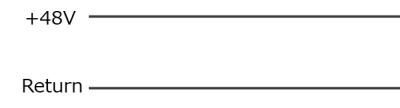
- Filter Configuration
| Products | Characteristics | P/N |
|---|---|---|
| - | - | - |
■π-type filter
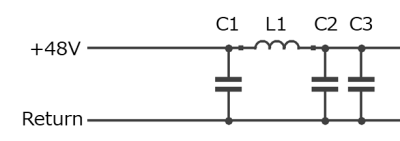
- Filter Configuration
| Products | Characteristics | P/N |
|---|---|---|
| C1/C2/C3 | 4.7μF | CGA5L1X7R2A475K160AC |
| L1 | 15μH | SPM7054VC-150M-D |
■π-type filter + common mode filter for power supply
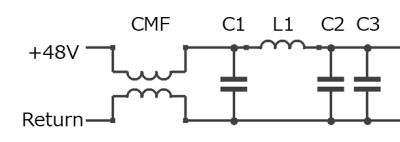
- Filter Configuration
| Products | Characteristics | P/N |
|---|---|---|
| CMF | 700Ω | ACM55V-701-2PL-TL00 |
| C1/C2/C3 | 4.7μF | CGA5L1X7R2A475K160AC |
| L1 | 15μH | SPM7054VC-150M-D |
Test Results
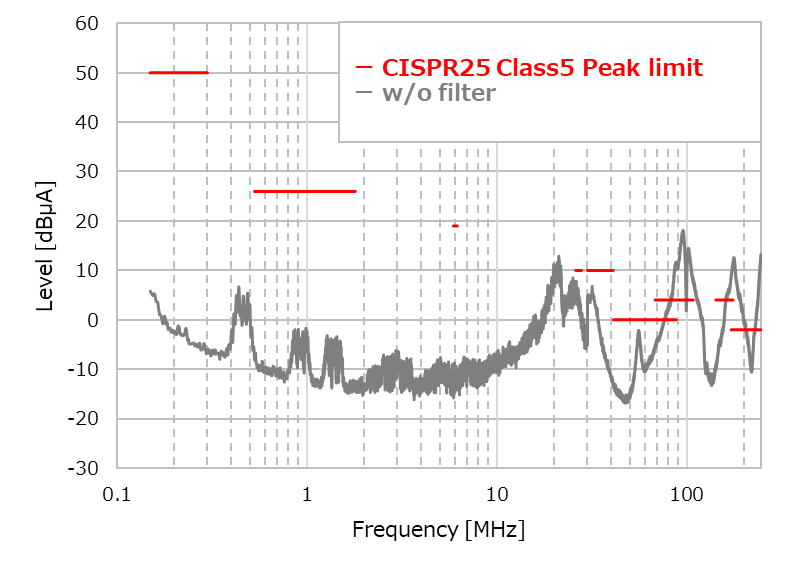
■No filter
- Conducted emission (voltage method)
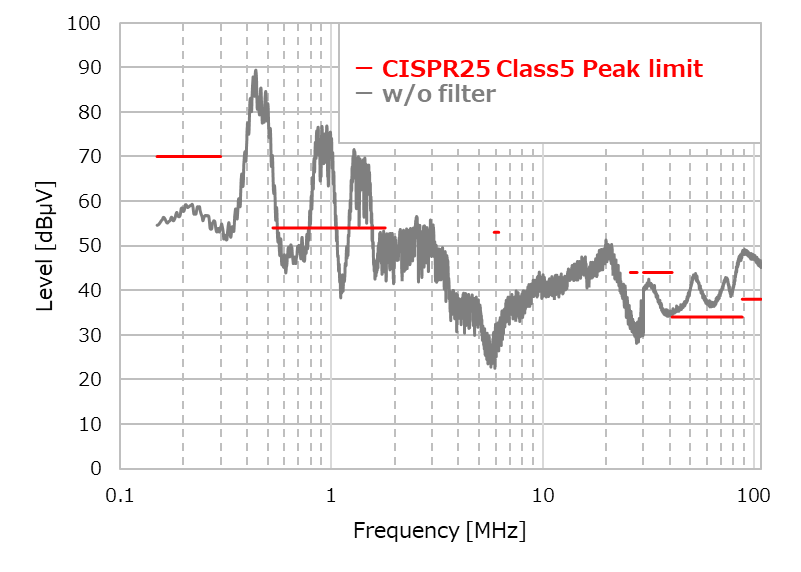
- Conducted emission (current probe method)
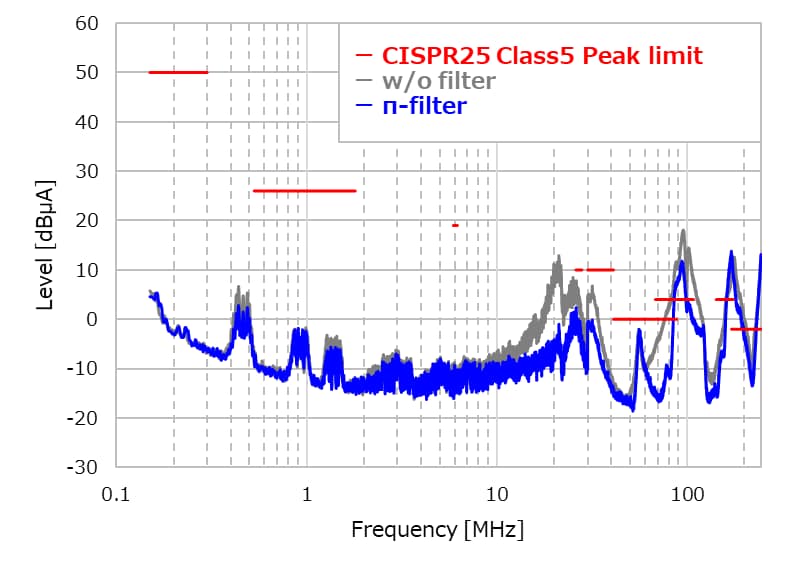
■π-type filter
- Conducted emission (voltage method)
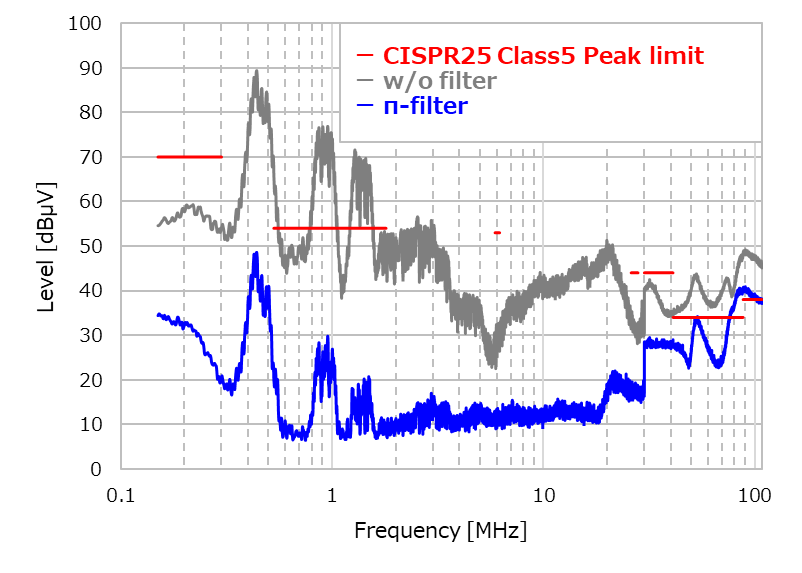
- Conducted emission (current probe method)
■π-type filter + common mode filter for power supply
- Conducted emission (voltage method)
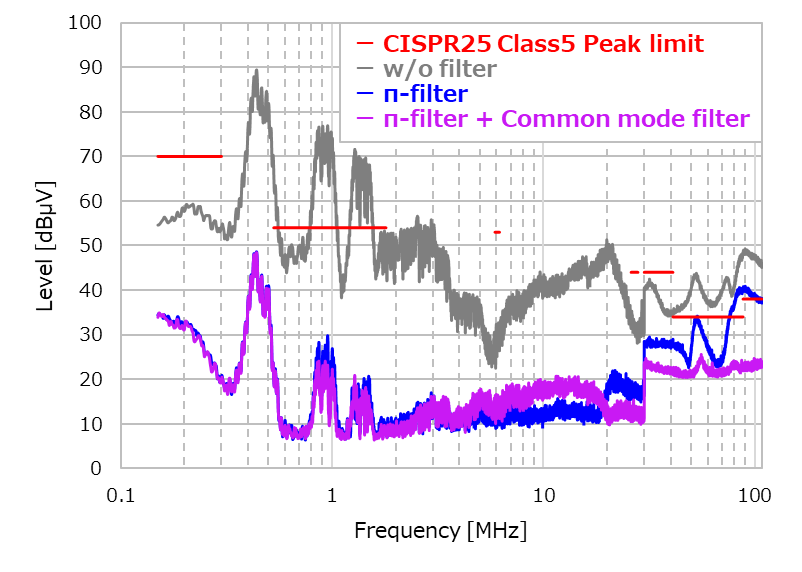
- Conducted emission (current probe method)
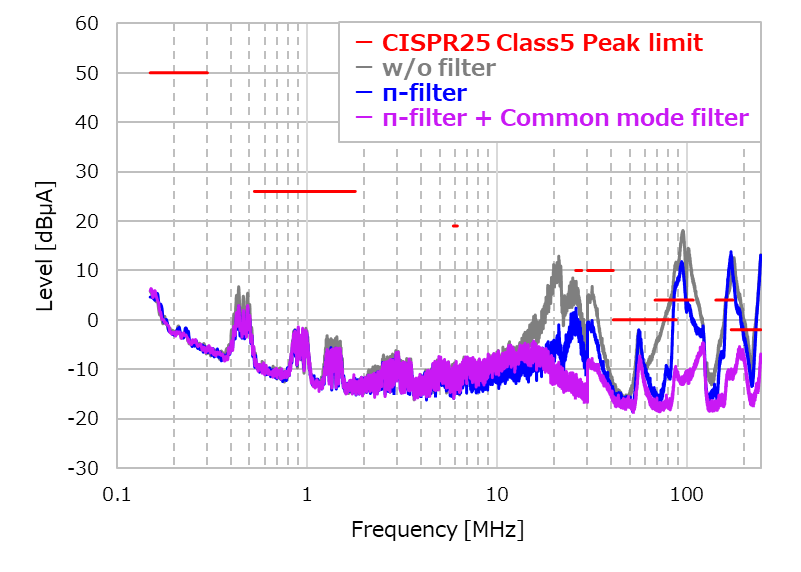
In the case without a filter, extremely high levels of noise exceeding the limit values were observed in both the voltage method and the current probe method. However, when a π-type filter was added, it was confirmed that noise in the AM band (0.53–1.8MHz) in the voltage method could be effectively suppressed. However, even after adding the π-type filter, high levels of noise exceeding the limit values were still observed in the frequency band above 70MHz in both the voltage method and the current probe method. For noise in the band above 70MHz, it was confirmed that adding a common mode filter for power supply could effectively suppress it. From these results, it was shown that a multi-stage input filter combining a π-type filter and a common mode filter for power supply is effective as a countermeasure for conducted emissions in 48V power supply systems.
*These measurement results are an example in a specific test environment. They do not guarantee compliance with the CISPR25 standard for the final product. Please confirm final compliance under actual usage conditions.
Product Lineup for Automotive 48 V Power Lines
At TDK, we offer a variety of products for 48V lines. Since each component has a specified rated voltage, please ensure you use them with sufficient margin.

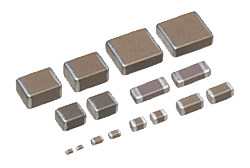
■MLCC Rated Voltage 100V Automotive Grade
| Series | L x W mm (EIA) | Standard Electrode | Resin Electrode | Mega Cap (Inline Type) | |||
|---|---|---|---|---|---|---|---|
| CGA2* | 1.0 x 0.5 (0402) | 0.001 to 0.01 uF | Detail  | ||||
| CGA3* | 1.6 x 0.8 (0603) | 0.001 to 0.1 uF | Detail | 0.001 to 0.1 uF | Detail | ||
| CGA4* | 2.0 x 1.25 (0805) | 0.047 to 2.2 uF | Detail | 0.001 to 1 uF | Detail | ||
| CGA5* | 3.2 x 1.6 (1206) | 0.047 to 4.7 uF | Detail | 0.1 to 2.2 uF | Detail | ||
| CGA6* CNA6* | 3.2 x 2.5 (1210) | 1.0 to 10 uF | Detail | 0.47 to 10 uF | Detail | ||
| CGA8* | 4.5 x 3.2 (1812) | 1.5 to 2.2 uF | Detail | ||||
| CGA9* CKG57* CAA57* | 5.7 x 5.0 (2220) | 3.3 to 15 uF | Detail | 10 uF | Detail | 1.0 to 47 uF | Detail |
-------------------------------
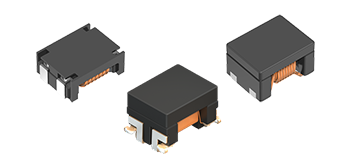
■Power Line Common Mode Choke/Filter Automotive Grade
| Part no. | Size L x W x H (mm) | Common Mode Z | DCR | Rated Current | Rated Voltage | IR |
| |||
|---|---|---|---|---|---|---|---|---|---|---|
| at 100MHz | 85deg.C | 105deg.C | 125deg.C | |||||||
| (Ω) min. | (Ω) typ. | (mΩ) max. | (A) max. | (V) max. | (MΩ) max. | |||||
| ACT32P-102-2P-TL01 | 3.2x2.5x2.5 | 750 | 1000 | 150 | 0.8 | 0.8 | 0.7 | 80 | 10 | Detail |
| ACM55V-701-2PL-TL00 | 5.5x5.5x3.5 | 500 | 700 | 17 | 4.7 | 4 | 3.1 | 80 | 10 | Detail |
| ACM70V-701-2PL-TL00 | 7.0x6.0x3.5 | 500 | 700 | 15 | 5.5 | 4.8 | 4 | 80 | 10 | Detail |
| ACM90V-701-2PL-TL00 | 9.0x7.0x4.5 | 500 | 700 | 10 | 8 | 7 | 5 | 80 | 10 | Detail |
| ACM90V-152-2PL-TL00 | 1100 | 1500 | 16 | 5.4 | 4.5 | 3.6 | 80 | 10 | Detail | |
| ACM12V-351-2PL-TL00 | 12.0x11.0x6.0 | 240 | 350 | 2.9 | 16 | 14 | 10 | 80 | 10 | Detail |
| ACM12V-701-2PL-TL00 | 500 | 700 | 6 | 11 | 11 | 8 | 80 | 10 | Detail | |
| ACM12V-172-2PL-TL00 | 1200 | 1700 | 12 | 7 | 6 | 4.8 | 80 | 10 | Detail | |
-------------------------------
-------------------------------
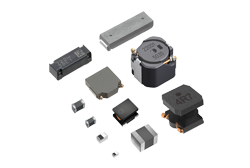
■Power Line Inductors Automotive Grade - Recommended Products for 48V Power Systems
| Series | L x W Size (mm) | T (Max.) (mm) | Rated Voltage (V) max. | DC resistance (mΩ) typ. | Inductance (μH) | Rated Current(Isat) (A) typ. (ΔL = -30%) | Rated Current(Itemp.) (A) typ. (ΔT = 40℃) | |
|---|---|---|---|---|---|---|---|---|
| SPM7054VC* | 7.5 x 7.0 | 5.4 | 80 | 4.3 to 334 | 1.0 to 100 | 3.4 to 26.8 | 1.8 to 16.2 | Detail |
| SPM10065VC* | 10.5 x 10.0 | 6.5 | 80 | 2.3 to 114 | 1.0 to 68 | 7.3 to 49.8 | 3.4 to 23.0 | Detail |
| SPM12565VC* | 13.0 x 12.5 | 6.5 | 120 | 2.1 to 30.4 | 1.0 to 22 | 14.5 to 58.9 | 6.9 to 25.4 | Detail |
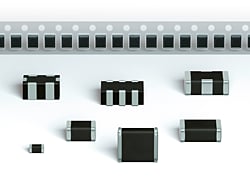
■ESD/Voltage Protection Devices Automotive Grade
Item | Chip Size mm (inch) | Operating Voltage (V) | Varistor Voltage (V) | Capacitance (pF) | Surge Current (8/20us) (A) | Energy (10/100us) (J) | ESD Durability 150pF/330Ω Contact (kV) | Operating Temp. (℃) |
|
|---|---|---|---|---|---|---|---|---|---|
| AVRM1608C720KT750M | 1.6 x 0.8 (0603) | 53Max | 72 (64.8 to 79.2) | 75 (60 to 90) | 40 | 0.1 | ±25 | -55 to +150 | Detail |
| AVRM2012C720KT201M | 2.0 x 1.25 (0805) | 53Max | 72 (64.8 to 79.2) | 200 (160 to 240) | 100 | 0.3 | ±25 | -55 to +150 | Detail |
Summary: EMC Countermeasures for Automotive 48 V Power Systems and TDK’s Comprehensive Support
Automotive 48V power supply systems are expected to become more widespread in the future due to benefits such as higher efficiency from reduced power loss. However, there are concerns about increased noise levels, and EMC countermeasures are expected to become more important than ever before. In actual measurement cases, it was confirmed that a multi-stage input filter combining inductors, MLCCs, and power supply common mode filters can effectively suppress noise over a wide frequency range from low to high frequencies.
At TDK, we offer a wide lineup of EMC countermeasure components suitable for automotive 48V power supply systems. In addition, we provide comprehensive technical support, including EMC measurement services, circuit design proposals, and noise countermeasure assistance. We offer total support from component selection to evaluation and verification, so please feel free to contact us.


Related Links